Newsroom
For journalists on deadline
A named expert who answers within two working hours, verified figures you can check yourself, open data you can download, and images cleared for editorial use. No form, no embargo, no gatekeeping.

Available for comment
Andreas Gunberg
Founder and press contact, WoodIntel™
Speaks on wood specification, facade service life, moisture and decay, durability classes under EN 350, and how evidence behind material claims can be checked. Comments in English and Swedish, on the record.
- Response
- Within 2 working hours
- Based in
- Gothenburg, Sweden (CET)
Figures you can check
50
European standards indexed
288
Calibrated model predictions
8.5 %
Median absolute error vs field data
83.3 %
Blind P10–P90 coverage
Recurring data release — Q3 2026
WoodIntel™ Exposure Index, Q3 2026 (WI-INDEX v1.0.0)
A versioned, citable dataset of modelled service life for exposed timber: 288 predictions covering 12 species across 6 climate zones, each a 1200-iteration Monte Carlo run with published uncertainty. Global median 21 years. Harshest zone: Singapore. Kindest zone: Pacific North-West, USA. Figures are modelled estimates, not field measurements.
Singapore
Af — tropical rainforest
14 yr
Mean modelled service life · treatment gain +4.2 yr
Riyadh, Saudi Arabia
BWh — hot desert
17.1 yr
Mean modelled service life · treatment gain +6.6 yr
Dubai, UAE
BWh — hot desert, coastal
18.5 yr
Mean modelled service life · treatment gain +5.6 yr
Stockholm, Sweden
Dfb — humid continental
31.8 yr
Mean modelled service life · treatment gain +8.3 yr
Coastal Scotland
Cfb — temperate oceanic
32.3 yr
Mean modelled service life · treatment gain +8.3 yr
Pacific North-West, USA
Csb — warm-summer mediterranean
32.9 yr
Mean modelled service life · treatment gain +8.4 yr
Cite as: WoodIntel™ Exposure Index (WI-INDEX v1.0.0), generated 2026-08-03. Available at https://woodintel.io/wood-index. Modelled estimates; method WI-SL published at https://woodintel.io/method.
Story angles, with the data behind them
Climate moves the answer more than the species does
The same timber differs by 28 modelled years between the kindest and harshest zone in the index. Acetylated Radiata Pine models at 48 years in Coastal Scotland and 20 years in Singapore.
Open the datasetSpecification claims are rarely checkable
Every figure on this platform resolves to a published equation, a European standard or a named field trial. The validation benchmark is open: 24 cases, 8.5 % median absolute error, 9.5 % blind.
See the benchmarkTreatment gain is smaller than the marketing suggests
Across the indexed zones, surface treatment adds a mean of 6.9 modelled years to exposed cladding — real, but far below what a detailing error can remove.
Read the treatments guideWho funds the numbers matters
The platform was initiated and funded by SiOO:X Wood Protection. The funder has no influence on results or methodology, no product is recommended, and the full funding statement is published.
Funding and independenceStatements cleared for quotation
These are pre-approved and attributable to Andreas Gunberg, WoodIntel™. Use them as they stand, or email for a comment written to your specific question.
On modelled estimates
“Every number we publish is a modelled estimate with a stated uncertainty range, not a measurement. If a figure cannot be traced back to a standard, a climate dataset or a peer-reviewed study, it does not belong on the platform.”
On climate versus material
“In our index the climate zone moves the expected service life of exposed timber more than the species choice does — up to 28 years for the same material between zones.”
On detailing
“Most premature facade failures we can reproduce in the model are detailing problems rather than material problems: trapped moisture, blocked drying, end grain left open.”
On independence
“The platform is funded by a wood protection manufacturer and still recommends untreated timber wherever the evidence supports it. That is the point of publishing the method in full.”
On what the platform is not
“WoodIntel is an independent open platform, not a research institute and not a certification body. We synthesise published evidence; we do not issue approvals.”
Images for editorial use
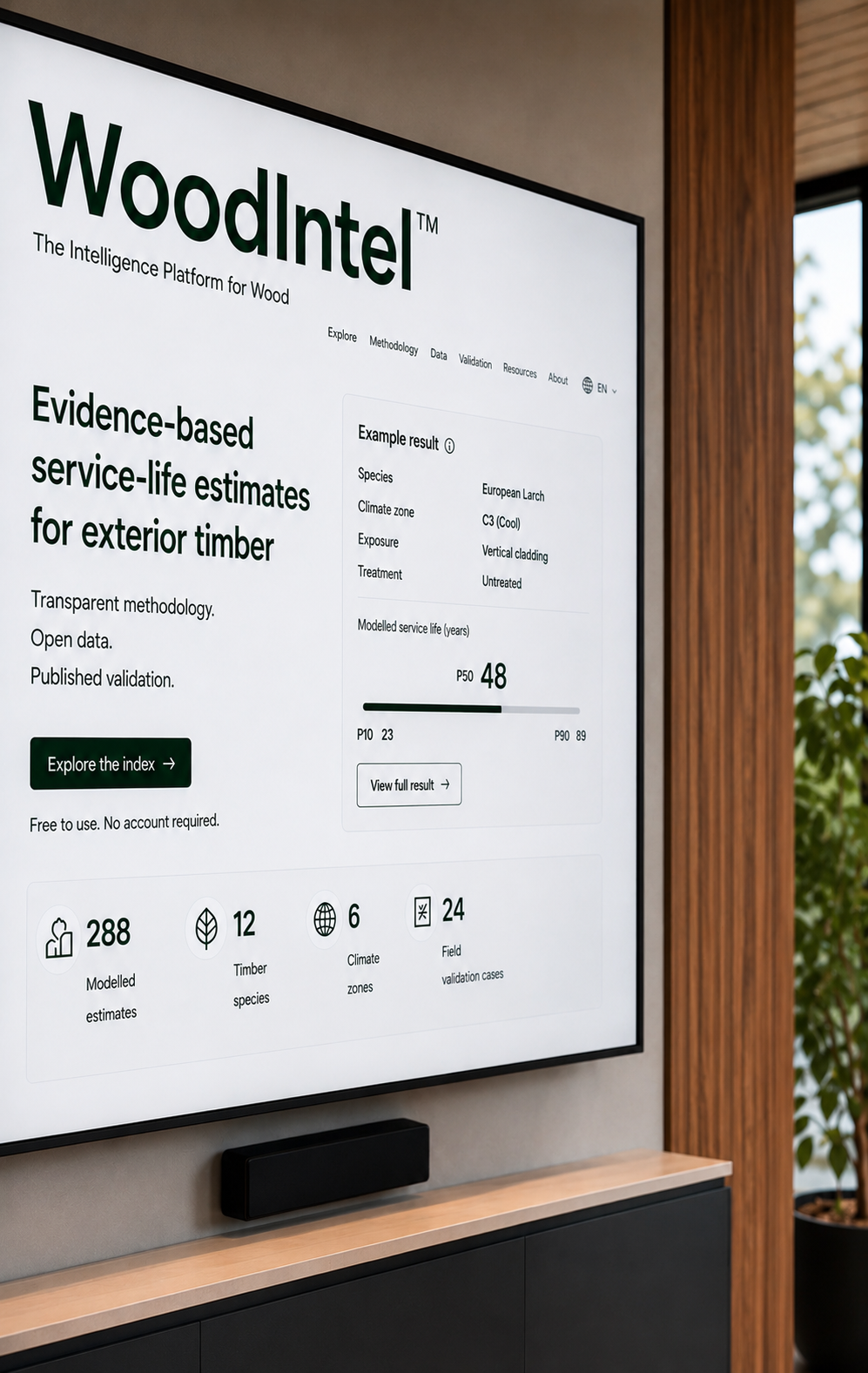
High resolution, free to use with attribution (CC BY 4.0). Credit: WoodIntel™.
Ground rules and independence
- WoodIntel™ is an independent open platform, not a research institute or certification body.
- Initiated and funded by SiOO:X Wood Protection. The funder has no influence on results, method or published data.
- No supplier, product or trade name is recommended or endorsed anywhere on the platform.
- All model output is labelled as a modelled estimate with an uncertainty range, never as measured reality.
- Method, calibration and validation are published in full and free to reproduce.
- Found an error? Send it to the press contact — corrections are published with a dated note.